
Loading titles…
Herself
Herself
Herself
Himself
Herself
Herself

Istanbul: Chronopolis is an experimental documentary that explores the city as a living organism where the linear flow of time is disrupted and the past and future coexist. Structured around a thematic cycle of birth, speed, and decay, the film uses rhythmic visuals and archival footage to bridge temporal gaps. Through a fourteen-minute mathematical edit, it replaces linguistic narrative with the evocative language of time-lapse and slow-motion cinematography. The project invites the audience to transcend chronological time and experience Istanbul as an eternal moment—an entity existing solely within its own timeless cycle.
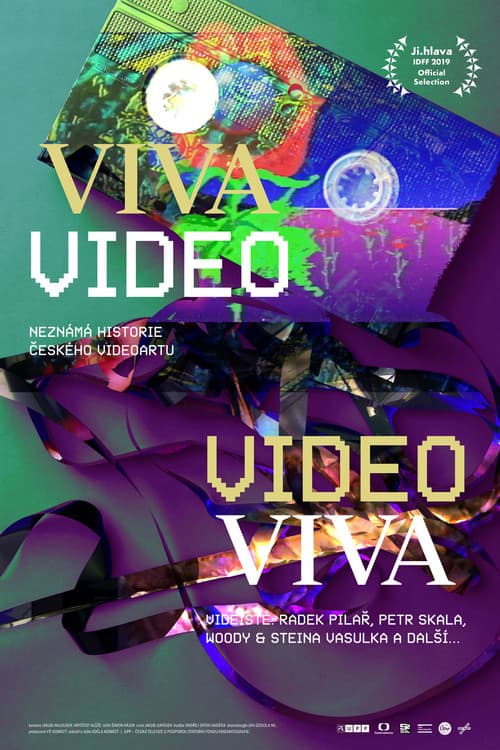
Today, analogue video is attractive primarily thanks to the distinctive aesthetic quality of its pixelated image and raster errors. But for Czech artists who first explored the possibilities offered by video art in the late 1980s, this medium represented a path towards freedom. Through a portrait of her grandfather Radek Pilař, one of the pioneers of Czech video art, the director explores her own legacy of imperative creative fascination. Her film’s main story, i.e., the process of reconstructing the 1989 exhibition Video Day, contrasts this enchantment with life in the final days of the totalitarian regime, which different sharply with the adventures of those who decided to emigrate – whom the filmmaker also visits in order to discover forgotten works, get to know their creators, and re-establish broken ties.

IDFA and Canadian filmmaker Peter Wintonick had a close relationship for decades. He was a hard worker and often far from home, visiting festivals around the world. In 2013, he died after a short illness. His daughter Mira was left behind with a whole lot of questions, and a box full of videotapes that Wintonick shot for his Utopia project. She resolved to investigate what sort of film he envisaged, and to complete it for him.


A kinetic prayer and structuralist intervention. Shot entirely on an iPhone 11 in a desolate Midwest laundromat, 108 spin documents the mechanics of impermanence. The film shifts from heavy turbulence to suspended repetition—not as a path to completion, but as a study of the loop itself. Featuring a layered soundscape, the work asks the viewer to stare into the rotation until the noise becomes a mantra.


In the year 2020, when the world was forced to ‘change’, I wanted to confirm what changed and what did not change in me. The white mask I wore became the screen projecting my past. My family is sometimes hurt, but support me as I suffer from schizophrenia. We live today while looking for the answer to ‘Who are we?’
In 2002, Lana Kaiser became well known in the first season of the German version of the Idol television franchise. She was born in 1985 and went by her birth name Daniel Küblböck. At only 17 years old she polarised the audience with her androgynous appearance and open bisexuality. On September 9th 2018, Lana disappeared from a cruise ship on her way to North America. Most media outlets and the majority of the public didn‘t consider calling her by her chosen name, Lana Kaiser. Philipp Gufler's video installation is a personal portrait of the singer and entertainer.


