Loading titles…
Documentary
Jonas Mekas documents Timothy Leary’s Millbrook estate in the wake of a police raid, juxtaposing serene images of the property with audio of officials justifying their actions. Blending diary footage with subversive reportage, the film exposes the gap between perception and…
No cast information available.
After receiving an anonymous phone call, the cops pick up a young woman who is wandering around alone in the desert. She tells them that she was given a lift by a stranger, who abandoned her there. Or are there more sides to one story? Part of a series of scare movies called Under the Law, distributed by Disney in the 1970s.
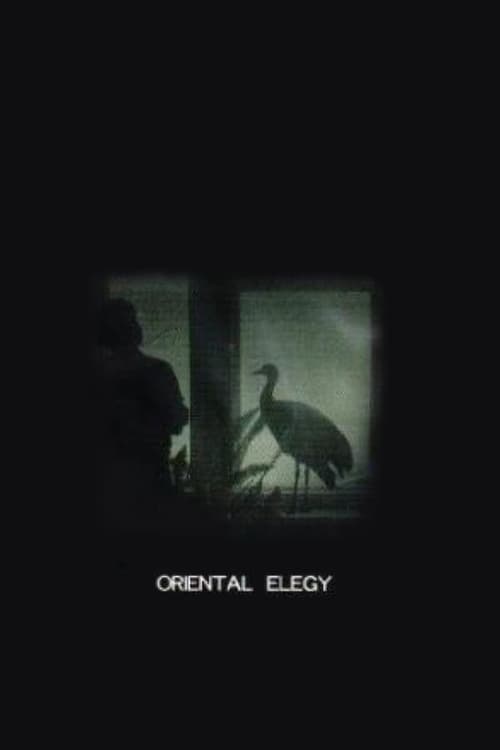
A surreal journey of a displaced spirit as he wanders in the interminable darkness through the temporal landscape of a quaint and isolated feudal-era fishing village. Guided by a series of faintly illuminated rooms, the wandering spirit comes upon ancient souls who take on physical forms as they recount their personal stories of daily existence, loss, and tragedy in the peasant community. Intrigued by his initial visit to a curiously distracted elderly woman, the spirit returns to her home in order to ask a fundamental question - "What is happiness?" - an existential query that is innocently answered with innate humility and accepted unknowingness.
Signed by neurology professor Camillo Negro and cinematographer Roberto Omegna for the Società Anonima Ambrosio of Turin, Neuropathology is one of the first and most significant scientific documentaries in the history of cinema. Premiering in Italy on February 17, 1908, this film meticulously records a series of clinical cases of patients with various pathologies of the nervous system observed at the Cottolengo Hospital and neuropathological clinics in Turin between 1906 and 1908. The material includes studies of convulsions, spasms, ocular paralysis, ataxia, epileptic seizures, and other neurological disorders, presented with a didactic and scientific objective for physicians and neurology students.
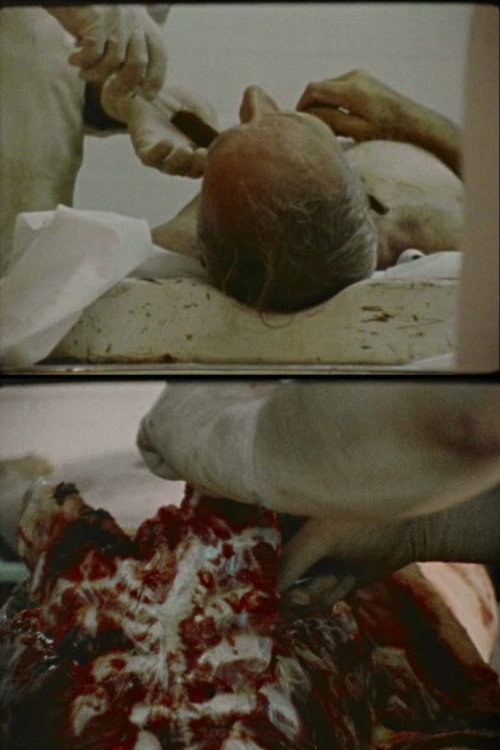
At a morgue, forensic pathologists conduct autopsies of the corpses assigned. "S. Brakhage, entering, WITH HIS CAMERA, one of the forbidden, terrific locations of our culture, the autopsy room. It is a place wherein, inversely, life is cherished, for it exists to affirm that no one of us may die without our knowing exactly why. All of us, in the person of the coroner, must see that, for ourselves, with our own eyes. It is a room full of appalling particular intimacies, the last ditch of individuation. Here our vague nightmare of mortality acquires the names and faces of OTHERS. This last is a process that requires a WITNESS; and what 'idea' may finally have inserted itself into the sensible world we can still scarcely guess, for the CAMERA would seem the perfect Eidetic Witness, staring with perfect compassion where we can scarcely bear to glance." – Hollis Frampton