Loading titles…
Documentary
This captivating documentary from the History Channel recounts the development of iconic physicist Albert Einstein's provocative theory of general relativity. Some 200 years after the introduction of Isaac Newton's law of universal gravitation, Einstein rocked the science…
No cast information available.


Who invented time, who invented the clock? Why 1 hour, why 60 minutes, why 60 seconds? Since prehistoric times, man has sought to measure time, to organize social and religious life, to plan food supply... Today we can surf the Internet, geolocate, pay by credit card… All our daily lives depend on time and the synchronization of clocks. The history of the invention of time and of the ways and instruments to measure it is a long story…

John von Neumann, one of the most incredible Hungarian-born scientists of all time, was named Man of the Century by the Financial Times in 1999. Among other scientific works, Neumann pioneered game theory and, along with Alan Turing and Claude Shannon, was one of the conceptual inventors of the stored-program digital computer. In late 1943 Neumann began to work on the Manhattan Project at the invitation of J. Robert Oppenheimer, and helped to design the first atomic bomb. This biography showcases the famous mathematician's work and legacy from the perspective of his daughter and colleagues. It is based on artefacts and documents from scientific history collections and on the personal memories of Marina von Neumann Whitman, Neumann's daughter. The film's production team has been filming all around the world, from Budapest to Los Alamos and Princeton, with the participation of several Hungarian and American scientists.

The core of the video is a pedagogical workshop on the Theory of Special Relativity as part of the educational process conducted by our youth leadership. Not for the sake of understanding the theory itself, but using Einstein's particular discovery as a case study to demonstrate and walk people through real human thinking, as being something above sense perceptions or opinions. We end with reflecting on the principle of relativity in terms of social relations and individual identities or thought processes, asking the question - how was Einstein able to make his breakthrough?

On November 25, 1915, Einstein presents his famous General Theory of Relativity. Just a few years later, his revolutionary ideas about space and time are confirmed during a solar eclipse. Overnight, Einstein became a scientific superstar. Einstein skillfully uses his popularity to give a war-torn world what it longs for: his genius, his humanitarian ideals, his unconventional appearance, his civil courage. Einstein's judgment was soon in demand far beyond the field of physics.

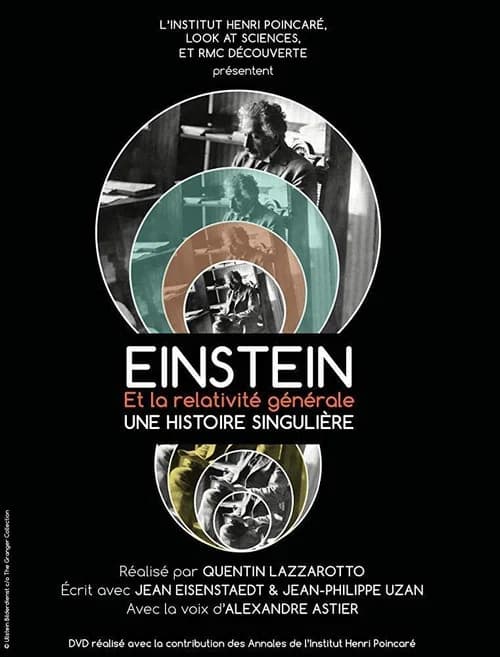
Albert Einstein's theory of general relativity has revolutionised our understanding of gravity, space and time. Initially acclaimed, then forgotten, and now rediscovered, the adventure of this hundred-year-old theory has marked the scientific history of the 20th century. From its inception, a mathematical difficulty arose that could have nipped the theory in the bud: the Schwarzschild singularity. In the company of great international relativistic physicists, the viewer embarks on a discovery of this theory with a singular destiny. We discover a "curved" universe that proves to be even stranger than Einstein had envisioned, and harbours some objects - such as black holes - that still challenge today's scientists.