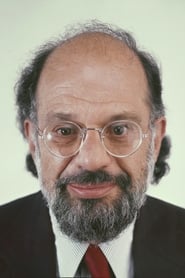
Allen Ginsberg
Self
Paik produced this exuberant, high-speed collage as a commission for the National Fine Arts Committee of the 1980 Olympic Winter Games. In a fractured explosion of densely layered movement and action, images of Olympic sports events are mixed with Paik’s recurring visual and…
Self
Migrating by sea from Holland as an eight-year-old, Dirk de Bruyn went on to be a doyen of Australian experimental cinema. But as this intimate film reveals, his work is suffused with the trauma of migration, and the struggle to recognise himself as a ‘new Australian'. In conversation with documentarian Steven McIntyre, Dirk guides us through more than 40 years of his filmmaking: the early years exploring technique and technology, a subsequent phase of unflinching self-examination brought on by upheaval and overseas travel, and more recent projects where he attempts a fusion of personal, cultural, and historical identity. What emerges is an inspiring, rugged, and at times poignant portrait of an artist committed to self-expression and self-discovery through the medium of film.
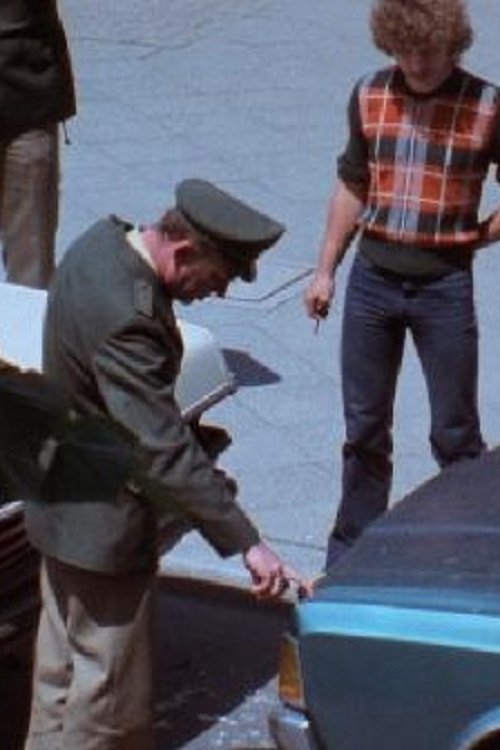
For years I've been looking for the means to capture everyday life just as it is perceived through a glance from the street. Twenty years ago, you could see young people standing with their bicycles on street corners, in fact, if the bicycles where there, you could be sure to find the young people standing there talking. I would like to document these kinds of events. On this occasion, I was presented with the opportunity to do so. For two and a half weeks, I walked around different parts of the city with my camera and collected images for the film. (Harun Farocki, 1979)

The constant movement of the wheels, threads, sprockets, feet and hands suggests restlessness, and this is paralleled by the soundtrack. The unknown woman could be Gretchen from Faust, hopelessly in love or Ariadne who gave Theseus the thread to find his way out of labyrinth or perhaps she is one of the fates, weaving destiny… Enlarged from Super-8 to 35mm, the film is very grainy, in itself an homage to the medium of film which is also emphasized by the depiction of all kinds of turning machines, both in image and sound.
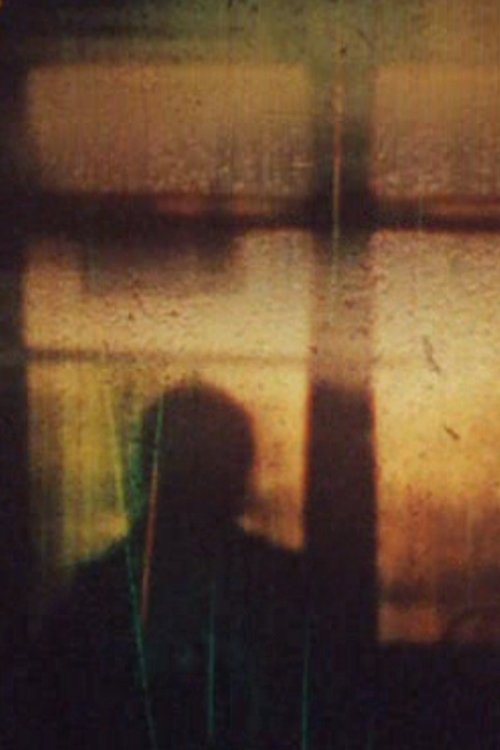
A wordless experimental collage of impressions and moods. Grainy fragments of landscapes, flakes whirl in the wind. Fog and mist, shadows of people in the city and by the water… Silhouettes that fade and turn into pure light and shadow until we discern the specks and scratches on the film strip itself. Sometimes, for a fraction of a second, a face, a person. A film as a memory that eludes us.
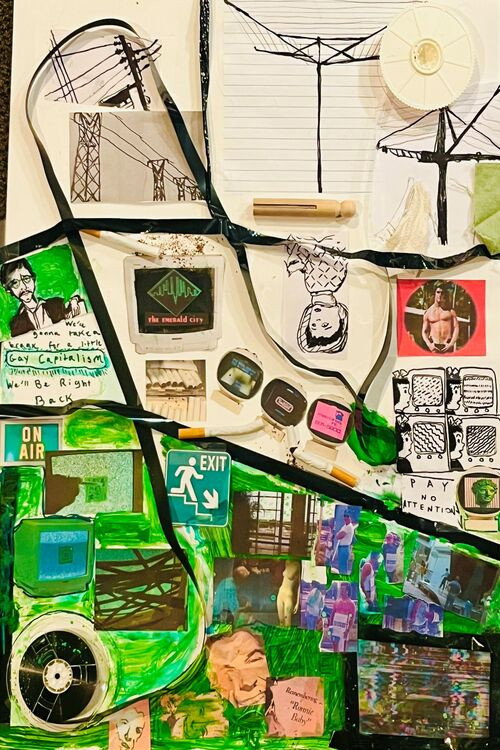
A continuously running two-channel installation, presented on 9" and 13" CRT monitors atop pedestals and overlooked by a green Kit-Cat clock. The smaller CRT bears a painted green square and is framed by a pair of crossed silver opera gloves, at whose intersection rests a vintage push-puppet of two boxers sharing a single red stand. Together, the two monitors display distinct video collages interweaving footage from Emerald Square Mall and the strike during its 1989 construction with remixed interferences from Channel J's Emerald City TV (1976–1979), Huge Video's Heat in the Night (1989), Genet's Un Chant d'Amour (1950), various cigarette commercials, The Wizard of Oz (1939), and a performance of a mylar-clad entity wrapping one of the televisions in videotape. The work has most frequently circulated publicly through its primary video channel.