
Loading titles…
Documentary
This video focuses on Dumagat activists, Nanay Nene, Tatay Lope, and Chieftain Rodrigo and their continuous struggle to organize resistance against a Chinese-funded mega dam in Quezon. The Kaliwa Dam Project will displace numerous Dumagat and non-Dumagat families living near the…
No cast information available.

"Letters from Europe" brings to light the words of men and women who gave their lives resisting the Nazi and fascist conquest from 1939 to '45 across the European continent. The moving goodbyes penned by a few of those sentenced to death are sometimes true spiritual testaments that explore the meaning of civic responsibility, human existence, fraternity, and life and death. Their words, which the film mingles with footage of the present day, can perhaps restore meaning to a humanist ideal and to the ever-changing idea of a united Europe.

When France rumbles, the strategy and control of public order become a crucial political issue. Between protecting institutions and guaranteeing the right to demonstrate: the right balance is subtle. At the beginning of the Yellow Vests movement, at the end of 2018, the principles of "French-style" policing were shattered. The ransacking of the Arc Triomphe, the hundreds of injuries among the demonstrators and the forces of order mark the minds. How did it come to this? In order to understand, the film questions the so-called "legitimate" force and confronts them with the images of these confrontations.


Britain's Special Operations Executive (SOE) provides trained agents, arms and other assistance to the European resistance groups fighting against Hitler. British agents, Captain Harry Rée DSO, OBE, Croix De Guerre, Médaille de la Résistance, aka "Felix", and Jacqueline Nearne, MBE, aka "Cat", recreate some of their adventures in France.

These are the first images shot in the ALN maquis, camera in hand, at the end of 1956 and in 1957. These war images taken in the Aurès-Nementchas are intended to be the basis of a dialogue between French and Algerians for peace in Algeria, by demonstrating the existence of an armed organization close to the people. Three versions of Algeria in Flames are produced: French, German and Arabic. From the end of the editing, the film circulates without any cuts throughout the world, except in France where the first screening takes place in the occupied Sorbonne in 1968. Certain images of the film have circulated and are found in films, in particular Algerian films. Because of the excitement caused by this film, he was forced to go into hiding for 25 months. After the declaration of independence, he founded the first Algerian Audiovisual Center.

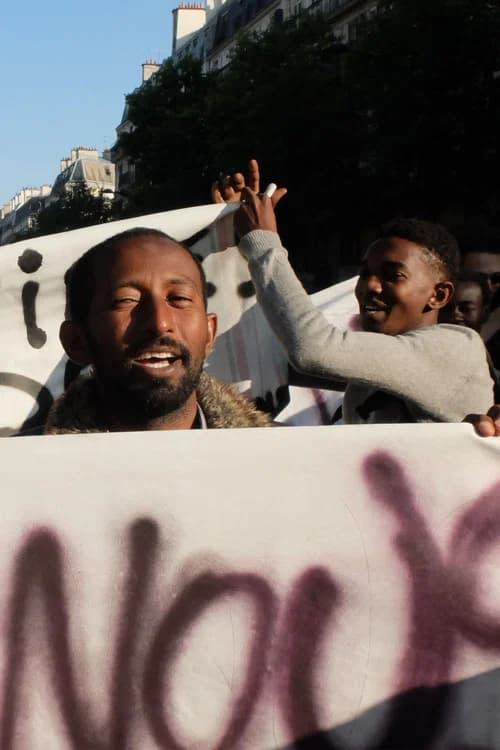
La Chapelle neighbourhood, Paris. Hundreds of exiled people from East Africa survive on the streets, chased violently by the police, yet seeking to defend their rights as asylum seekers. Some months later, having finally obtained their rightful housing, two Sudanese young men return to the sites where they first landed and talk about their arrival in Paris during this agitation.

