
Loading titles…
Documentary
Theo Maassen grew up in Germany and was the only boy in his class in '74 not to become World Champion. With the European Championship approaching and football as a starting point, Theo gives an adventurous tour to get to know the real Germany. Are the Germans smarter, faster,…


TheTheo visits Germany's largest comedy festival to unravel German humor. He dives into the audience of the Dutch comedian Patrick Nederkoorn, who has been performing successfully in Germany for years with his program Die Orangene Gefahr. The internationally recognized fact that Germans have no humor raises questions: why are they always so serious? Why can't they just make a joke for once? Theo investigates the difference between German and Dutch humor and finally ends up at a blind football tournament.

Theo speaks in Berlin with Rudolph Herzog, who researched humor in the Third Reich. He discovered remarkable things. Theo also speaks with the half German-half Dutch Sven Ratzke about the disappeared art of Das Kabarett. And he is present at the Deutsche Tag der Wiedervereinigung, the day on which it is celebrated that the Wall fell and Germany became one country again, but they do not seem to be that united.

Theo meets his German voice double Claus-Peter, also the voice of the German Miss Piggy. In Germany, all films and TV series are dubbed, including Theo's. What can we Dutch learn from these living voice-over machines that manage to squeeze the German language into a film at the millisecond's notice? Theo continues to the cradle of electronic music; Dusseldorf. Birthplace of Kraftwerk who saw themselves as the ultimate Mensch-Maschine. Finally, Theo is with Linh Tran. This lady is a seven-time table football world champion. Her nickname: Die Maschine.
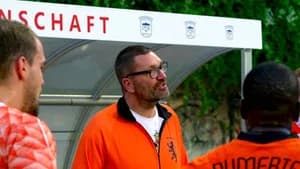
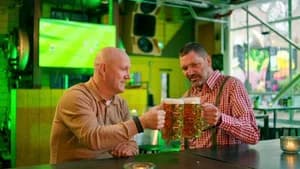
Theo discovers that German culture is actually very unifying: from the traditional Frühschoppen to the endangered club culture of Berlin's nightlife. Everyone is equal. Or is it all just an excuse to drink beer? Theo also visits a special phenomenon: the German National Writers' Team. Why don't we have that? Germans see culture as an essential necessity of life and attach fundamental importance to it. How people express themselves and how they celebrate says a lot about their innermost being; their soul.
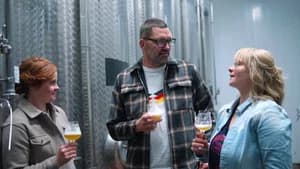
In Berlin, Theo visits the star restaurant Nobelhart & Schmutzig, where they have made traditional German cuisine attractive again. Near Munich, Theo goes out with Gisi and Moni Meinel-Hansen, two young sisters who run a centuries-old family brewery. Theo helps during the traditional Bockbieranstich in the brewery. Food and drink are the fuel of every footballer, but German food and drinks are not known for being particularly tasty or healthy. Yet Germans become world champions on a diet of beer and bratwurst. The central question: what is the secret behind the Germans' fuel?
The 1974 World Cup title was actually stolen from us. Because the final was not lost on the field, but here, in this swimming pool. And Theo has tracked down the person responsible. Our national penalty trauma is also being examined: with Dutch national team and Borussia Dortmund handball goalkeeper Tess Wester and German penalty professor Daniel Memmert.

Self

The specter of drug trafficking haunts Europe. Struggling with ultra-violent criminal groups that control the vast majority of cocaine trade, European police forces are overwhelmed. The epicenter of all this trafficking: the Netherlands. A nation at the forefront of international trade and drug policy. This two-part film delves into the origins of European drug trafficking through the unique history of the Kingdom of the Netherlands.

Germany loves biathlon – and you’ve never been this close to the stars. The documentary series accompanies them through a dramatic year and shows tears, pressure, and emotional moments from the inner workings of the team. It tells of fierce competition and the struggle to return to the top of the world in 2024/25. The camera is there when there are arguments, laughter, and celebrations behind the scenes – as in the case of Franziska Preuß’s spectacular overall World Cup title.


The six-part documentary series follows a training course for mine clearance divers – a specialized unit tasked with finding and defusing mines. Eleven men undergo a grueling training program: freediving to the point of near unconsciousness, deep dives, forced marches, weeks at sea, and helicopter jumps from a height of ten meters into the Baltic Sea. While the instructors meticulously record every mistake, the trainees struggle with cold, exhaustion, and self-doubt. The series reveals their motivations, their courage, and their determination to assume responsibility in a tense global situation.


A century ago, the world experienced a revolution in mobility. Cities like Berlin grew rapidly, with the Graf Zeppelin soaring over the city in 1928, sparking excitement for airship travel. These majestic airships made ocean crossings faster and more luxurious, and even enabled polar expeditions. At the same time, automobiles and motorcycles became staples for many, although streets became congested. Women like Amelia Earhart and Elly Beinhorn broke barriers in aviation, inspiring new possibilities for both genders in the field of technology. While air travel grew in popularity, trains remained the main long-distance transport. The era also saw an explosion of new mobility options, with faster, cheaper ways to travel across the globe, making the world seem smaller and more connected. However, this golden age of mobility would be cut short by the outbreak of World War II.

Once voted out, written off countless times, convicted multiple times – and unstoppable. The comeback of the century: Trump is transforming the USA. And perhaps even the world? This documentary tells the story of an American president who stirs up and unsettles Europe with deals and harsh words. What is his strategy and what has he achieved with it so far? How is Germany responding? How is Europe faring? And what will become of the America we knew? Will the “system crasher” Trump merely dismantle bureaucracy and inefficiency – or democracy itself?


