


Loading titles…
Documentary
The Secret Life of Machines is an educational television series presented by Tim Hunkin and Rex Garrod, in which the two explain the inner workings and history of common household and office machinery. According to Hunkin, the show's creator, the programme was developed from his…


Before the invention of the vacuum cleaner, carpets and upholstery were taken outside and beaten once a year to get the dust out (the 'Spring' clean). Fitted carpets were totally impractical. Episode Contents: Models: Three different kinds (cylinder, upright, hybrid) of cut away vacuums. Homemade solenoid. Plastic bag car jack. Machines: Tim's automated hair raising, eye rolling portrait. Tim's "Common Ground" collecting box which simulates different footprints using a vacuum and a sheet of rubber. Guests: An array of ineffective hand powered vaccuums. Films: Singin hoover ad from the 30's. Extro: Flying vacuums!
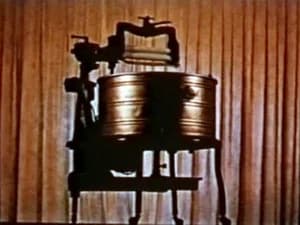
The earliest form of automatic washing was the nautical practice of towing clothes behind the ship. The combination of agitation and a constant flow of clean water washes the clothes quite effectively. Episode Contents: Models: Solenoid valves and pressure switches explained. Various cut away washing machines and their ingredients: weighted base, heating element, pumps, timer. Machines: A thunder simulator by Tim. A stunt by Rex using a solenoid cannon to roll a car. One of the best of Tim's collecting boxes, the Chiropodist who nods, twiddles her thumbs and then dissapears and tickles your foot (automatic british mickey taking at it's best). Guests: Again, lots of antique specimins (including the canadian shocker!). Industrial washing machines and the way they deal with the eccentricities of a load of water. Extro: A mountain of washing machines.

The first patent for a sewing machine was taken out by an English cabinetmaker called Thomas Saint in 1790. It's doubtful whether he actually built his design, because, when one was made from his drawings 100 years later, it had to be extensively modified to work. Episode Contents: Models: A giant human powered lock stitcher demonstrates the basic idea. A cut away singer shows how a crank powers all the basic functions. A demonstration of cams and stepper motors. Machines: Three of Tim's famous collecting boxes: The head scratching curator the rubber-necked guard and the doctor that writes out illegible prescriptions. There are some brief close ups of the construction of these machines. Rex also shows his magical remote controlled suitcase. Guests: A thumb crushing Thimmonier (the 1st practical sewing machine) Many antique decorative sewing machines. Films: The old Singer advert from the 40's is probably the funniest clip in this series. Extro: Say it in thread.

Commercial refrigeration equipment was first developed in Australia, where the winters weren't cold enough to produce much natural ice. A brewery was the first company to commission an artificial ice making plant (in 1865) so cooling Australian lager was the first use of artificial refrigeration. Episode Contents: Models: Disassembling a compressor. Demonstration of thermostat Machines: Rex's homemade air rifle. Tim's elaborate wall mounted water clock. Guests: Early ice box. A turn of the century ammonia refrigerent ice factory. Various early fridges. Archival: GE film from 1935 starring Bette Davis. Hilarious old promo from 1957 with a woman hugging her fridge! Goofy commercial involving an elephant and an old style fridge. Extro: Stop motion fridges.

At first Roman houses simply had a fire in the middle of the room (the Latin for hearth is focus). But they probably had trouble with smoke as the Latin for living room is atrium (from ater meaning black). By about 400AD the Romans had perfected a form of central heating. The fire was lit outside in a furnace with hot air ducts under the floors and in the walls. Episode Contents: Models: Trying to start a fire with an electric drill. A Norman chimney vs a proper one. A life size 2 dimensional house model with radiators and boiler. A glass radiator. A balanced flue. Machines: Jacob's ladders by Rex. Guests: Solid fuel, oil and natural gas boilers. Films: Yet another silly 40's promotional film, this one for the Ascot gas boiler. Extro: The model house springs a leak.

John Logie Baird, the Scottish inventor, developed an electromechanical TV system in the 1920s and gave frequent public demonstrations. The publicity encouraged EMI to develop a practical all-electronic system, similar to today's. In 1936 the BBC transmitted both systems, but EMI's was judged superior. Episode Contents: Models: TV scanning is demonstrated with a drawing made on many strands of string. A cutaway TV and cards that mimic the screening of a colour TV. Explanation of the simplest electronic components. Machines: Tim's displays at the National Film and Television Museum (UK) Guests: British TV sets from before and after WWII. Films: Zworykin interview. J.L. Baird cartoon. Extro: A mountain of live televisions set on fire.
Self - Presenter
Self - Co-Presenter


MythBusters is a science entertainment television program created and produced by Australia's Beyond Television Productions for the Discovery Channel. The show's hosts, special effects experts Adam Savage and Jamie Hyneman, use elements of the scientific method to test the validity of rumors, myths, movie scenes, adages, Internet videos, and news stories.

Australian host Steve Irwin and his wife Terri run a wildlife refuge. Their shared passion is educating the world about wildlife, including the much feared crocodile and numerous venomous snakes. Steve's specialty is the capture and relocation of crocodiles. No animal appears too threatening to Steve, his true respect for animals is the foundation for everything he does.

This is your chance to reach out and touch the past! Just as a forensic anthropologist analyses bones, and a historian deciphers ancient texts, we now have the technology to "read" the buildings, ruins and landscapes where history was made. The series, presented by Dallas Campbell, teams Steve Burrows (pictured), the brains behind the Bird’s Nest Stadium in Beijing, with a team of pioneering laser scanning experts from the Centre for Advanced Spatial Technologies to unlock the secrets of the world’s greatest engineering and cultural achievements. Locations include the Colosseum, Petra, Machu Picchu, St. Paul’s Cathedral, the Pyramids and Jerusalem.

It is 2014 and the machines have not taken over…yet. The newest, most technologically advanced series from H2™, Rise of the Machines, reveals how the inventions behind the world’s most extreme machines have enabled them to evolve beyond humanity’s wildest imagination. This visually stunning series uses mind-blowing CGI animations to reveal the extraordinary engineering at the heart of the world’s most extreme machines. From the world’s biggest mega truck to the world’s fastest train to a revolutionary heavy lift ship, ground breaking CGI animation explodes the machines apart to reveal the ingenious inventions hidden under their skin that enables the teams who drive, fly and sail them to be at the top of their game. This series takes us inside these machines in close up detail and explores what helps these elite ships, trucks, trains and aircrafts rise above all others.


This series presents a number of unique vehicles that helped to shape Australia's automotive history. We briefly look at some of the most iconic cars to hit the Australian highways ( goat tracks ) and why we loved or hated them and how they faired on our roads and race tracks. Some of these cars are unique to Australia, while other cars will be instantly recognised in other parts of the world. Some international models were renamed and rebadged for the Australian market, but you may still recognise them just the same. We've asked automotive journalists Mark Oastler, John Wright & Joe Kenwright to present their exclusive articles for the Shannons Club in a television format.

Attention please! Are you ready for an adventurous tour through the human body? With a lot of humour, our physical appearance is being introduced from head to toe along cells and organs in an educational way. The heart, blood, nerves and kidneys, each single one is a miracle which renders life possible.

Relive the biggest events of Australian Motorsport history in 'Shannons Legends of Motorsport', hosted by Neil Crompton. In an entertaining 12 part series, Neil Crompton, Australia's premier motoring commentator, brings to life the history of Australian Motorsport with rarely seen historical footage from Seven's extensive archives dating from the '60's to the '90'. In the he second 12 part series, hosted by Bill Woods and Aaron Noonan, they interview many of our Australian motorsport legends and reveal even more historical footage taken from the Network Seven archives. The third 15 part series includes a number of short clips outlining some of the most iconic people, cars and race events in our Australian automotive history.
