

Loading titles…
Documentary
Tales of the Unexpected is a new strand of provocative, confronting and thoroughly entertaining science documentaries. Each episode reveals a fascinating, sometimes awkward, and frequently unsettling world where peculiar ideas are put to the test. Come with us to where nothing…
New science is revealing breasts in a way that we’ve never seen them before. For years we’ve been seeking perfection: shape, size, and food source for our children. But now some scientists believe they may also be a hidden toxic waste ground. Putting breasts tissue - and breast milk - to the test, this documentary will investigate if these wonderful life-giving organs are under threat from the modern world and if they’re actually an early warning system telling us about the dangers of the chemicals around us.
For thousands of years, in fairgrounds and temples, palm readers have claimed our hands encode valuable information. Is this just superstition? Or is there, buried beneath the theatre and the cliches, a core of genuine science? Can our hands really tell us anything about our past, our present or our future? Does the lifeline on your hand reveal the age at which you’ll die? Can your hands detect your sexual preference? For the first time palm reading is put to the test and will debunk the myths that have been passed on for generations. This documentary will also have you looking at your own hands in a new light.
One in three children, claim many tabloids, may not be biologically related to the man they call Dad. Could this really be true? This program conducts the first ever purpose-designed paternity poll, asking some truly awkward questions. Comparing rates of paternity uncertainty in Australia and the United States, we ask what is the real rate of ‘non-paternity’, and might there be biological survival benefits for children born outside marriage? Following parents and children as they seek to uncover the truth, we discover how, today, there’s nowhere to hide your genes.
No cast information available.

Stephen Hawking’s Science of the Future investigates the very latest game changing innovations. Each episode takes one area of progress and sends five top scientists out to actively test the inventions and breakthroughs that are driving it. The team explore human upgrades, the virtual world, bio-mimicry, high-tech emergency responses, and more. Featuring a wide range of examples, from advanced robotics and breathtaking digital actors, to cutting edge smart homes and electronic brain stimulation, the series reveals how science is delivering astonishing improvements to all our lives. Using the evidence they gather, the team reveals the year when each innovation will be rolled out for us all to benefit from, and Hawking then draws out his own uniquely insightful predictions about what our world will be like in the years to come.
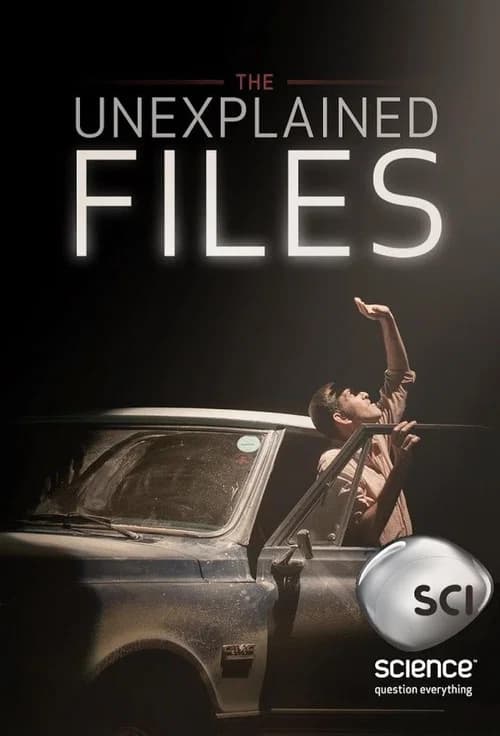
From strange abductions, to mutated species, to bizarre occurrences, there are some phenomena that science cannot - or will not - explain. This summer Science Channel unveils some of these shocking and mind-boggling cases from around the world in the world premiere series THE UNEXPLAINED FILES. From mysterious disappearances and UFO encounters, to unidentified fanged predators and reported curses, THE UNEXPLAINED FILES investigates actual, inexplicable occurrences that have confounded scientists and inspired legends. Science Channel invites viewers on a mystifying journey that will challenge disbelief with THE UNEXPLAINED FILES.

Geologist Iain Stewart explain in three stages of natural history the crucial interaction of our very planet's physiology and its unique wildlife. Biological evolution is largely driven bu adaptation to conditions such as climate, soil and irrigation, but biotopes were also shaped by wildlife changing earth's surface and climate significantly, even disregarding human activity.

In the series, "Wallace will take a light hearted and humorous look at the real-life inventors, contraptions, gadgets and inventions, with the silent help of Gromit. The series aims to inspire a whole new generation of innovative minds by showing them real, but mind-boggling, machines and inventions from around the world that have influenced his illustrious inventing career" (the BBC press statement). Peter Sallis reprised his role as the voice of Wallace. The filmed inserts are mostly narrated by Ashley Jensen, with one in each episode presented in-vision by Jem Stansfield. John Sparkes also voices a portion in the unseen character of archivist Goronwy.

NOVA scienceNOW is a News magazine version of the long-running and venerable PBS science program Nova. Premiering on January 25, 2005, the series was originally hosted by Robert Krulwich, who described it as an experiment in coverage of "breaking science, science that's right out of the lab, science that sometimes bumps up against politics, art, culture". At the beginning of season two, Neil deGrasse Tyson replaced Krulwich as the show's host. Tyson announced he would leave the show and was replaced by David Pogue beginning season 6.

Explore the mysterious regions inside the human body. See how vital organs interconnect to make human life possible. Learn how skeletons fit together. Witness the lightness and strength of bone, how muscles work as levers, what it takes to achieve the "perfect" body. See how the heart functions, and learn the roles of white and red blood cells. Discover the complex systems controlling breathing, digestion, glandular changes, and hearing.

A stunning new documentary series exploring the incredible story of uranium, from its creation in an exploding star to its deployment in nuclear weapons, nuclear power, and nuclear medicine. It’s a journey across nine countries and more than a century of stories, to discover the rock that made the modern world. It’s part science, part history, and all epic adventure. Join physicist and YouTube phenomenon Dr. Derek Muller as he reveals the untold story of the most wondrous and terrifying rock on Earth.

