


Loading titles…
Documentary
Guy Martin celebrates the workers of the Industrial Revolution by getting stuck into six of the country's biggest restoration projects, bringing some of the 19th century's most impressive engineering achievements back to life.


Guy helps to overhaul a steam locomotive used on the popular Severn Valley Railway, a 16-mile stretch of track in Shropshire preserved to look just as it did in the 19th century. He joins a team of volunteers, some as young as 17, to help repair its boiler, safety valves and one of its two-tonne wheels. He also lays some track using exactly the same methods as the notorious 'navvies' - the hard-drinking, hard-living labourers who laid Britain's railway infrastructure by hand. Guy learns the dying arts of the Victorian blacksmith to make a coal shovel out of wrought iron, and repairs a century-old train driver's pocket watch using washers just 1mm wide. If everything can be made to work then Guy will get the chance to try his hand at every young boy's dream job: steam train driver.

Guy works to get a Yorkshire saw mill up and running again, and then use it to make a replica of one of the less-celebrated inventions of the Victorian era: the first pedal-powered bicycle. Using his engineering skills, Guy helps the restoration team repair the ingenious water turbine that's needed to power the whole of Gayle Mill in Wensleydale, but which is currently leaking 43 litres of water a second. He ropes in his old mate Mave, who's a carpenter, to help fell a tree by hand, transport it to the mill on a steam traction engine and then use it to make his bike. Along the way, Guy learns about the lives of factory workers: the foot soldiers of the Industrial Revolution. He discovers how the mechanisation of farming left many with no choice but to head for the new industrial cities and towns and how child apprentices were often little more than slave labour. If Guy can get the mill running and build his bike, it'll need a test run and, as Guy is a man who likes a bit of an adrenalin rush, this is unlikely to be a gentle trundle across the dales!

Guy visits Llandudno to help get this Queen of Victorian resorts up to scratch in time for the summer season. The great British seaside holiday was a largely Victorian invention. Once it had caught on, tiny fishing villages up and down the country were transformed into giant pleasure parks complete with all the latest attractions. Over the course of the winter, Guy gets stuck into essential and dangerous restoration work on the town's magnificent pier, rebuilds a towering original helter-skelter ride and gets up to his elbows in grease servicing the town's funicular tramway. He learns how our appetite for sea-bathing began when word began to spread that it was good for the glands. He finds out how the engineering developments taking place in the great factories also led to a revolution in musical instruments. And he joins a brass band to play his part in a special promenade concert - with mixed results...

In this edition Guy's project is the first piston engine ever built. The Newcomen Beam Engine was the first practical device to harness the power of steam and kick-started the Industrial Revolution by allowing coal mining to operate on an industrial scale. Newcomen engines were used throughout Britain and Europe, principally to pump water out of mines, thereby allowing coal mining to go deeper and operate on a scale never before envisaged. If Guy and the restoration team at the Black Country museum can restore their Beam Engine to full working order it will be the only working example of this ground-breaking technology in the world. Success would mean witnessing the glorious sight of one the Industrial Revolution's most impressive inventions running again just as it first did 300 Years ago. Guy helps replace the rotting timber structure above the shaft, restore the worn parts and clean the boiler and he makes fire bricks the Victorian way to re-build crumbling brickwork around the engine. Meanwhile he learns about the lives of the men women and children who went down the mines to dig for coal. Joined by his girlfriend Steph, Guy heads deep underground to dig for coal and experience the almost impossible conditions that miners worked in.
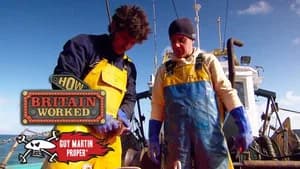
Guy helps restore the oldest surviving Brixham sailing trawler, the boat that launched the modern fishing industry and transformed the way a nation ate. Guy learns how the trawler's radical design saw off the competition, tries his hand at the precision joinery that made that design possible, tests his own version of an Industrial Revolution life jacket by jumping into the sea, and makes rope using the original machines that wove the ropes for Nelson's HMS Victory. He experiences deep sea trawling - said to be the most dangerous job of the 19th century - for himself, and discovers how Britain acquired its taste for fish and chips.

Birmingham Botanical Gardens may seem an unlikely place to explore the wonders of the Industrial Revolution, but hidden behind its fragrant borders Guy Martin finds a hidden world of hi-tech Victorian engineering, show-off architecture, intrepid plant-hunters scouring the furthest corners of the Empire, and city fathers terrified of the 'degenerate' urban poor. As Guy helps to get the gardens back into shape, he tries to learn one of the Industrial Revolution's most skilful and dangerous jobs: blowing glass for the gardens' enormous greenhouses. He has a go at rebuilding the very first lawnmower - another great British invention. Guy also uses a little-known 19th-century technique to make his own rock to go in the garden's restored rockery and then - if all goes to plan - he'll be given the job of turning on his newly installed fountain at the grand opening ceremony.

Himself


MythBusters is a science entertainment television program created and produced by Australia's Beyond Television Productions for the Discovery Channel. The show's hosts, special effects experts Adam Savage and Jamie Hyneman, use elements of the scientific method to test the validity of rumors, myths, movie scenes, adages, Internet videos, and news stories.

This is your chance to reach out and touch the past! Just as a forensic anthropologist analyses bones, and a historian deciphers ancient texts, we now have the technology to "read" the buildings, ruins and landscapes where history was made. The series, presented by Dallas Campbell, teams Steve Burrows (pictured), the brains behind the Bird’s Nest Stadium in Beijing, with a team of pioneering laser scanning experts from the Centre for Advanced Spatial Technologies to unlock the secrets of the world’s greatest engineering and cultural achievements. Locations include the Colosseum, Petra, Machu Picchu, St. Paul’s Cathedral, the Pyramids and Jerusalem.

It is 2014 and the machines have not taken over…yet. The newest, most technologically advanced series from H2™, Rise of the Machines, reveals how the inventions behind the world’s most extreme machines have enabled them to evolve beyond humanity’s wildest imagination. This visually stunning series uses mind-blowing CGI animations to reveal the extraordinary engineering at the heart of the world’s most extreme machines. From the world’s biggest mega truck to the world’s fastest train to a revolutionary heavy lift ship, ground breaking CGI animation explodes the machines apart to reveal the ingenious inventions hidden under their skin that enables the teams who drive, fly and sail them to be at the top of their game. This series takes us inside these machines in close up detail and explores what helps these elite ships, trucks, trains and aircrafts rise above all others.

This series presents a number of unique vehicles that helped to shape Australia's automotive history. We briefly look at some of the most iconic cars to hit the Australian highways ( goat tracks ) and why we loved or hated them and how they faired on our roads and race tracks. Some of these cars are unique to Australia, while other cars will be instantly recognised in other parts of the world. Some international models were renamed and rebadged for the Australian market, but you may still recognise them just the same. We've asked automotive journalists Mark Oastler, John Wright & Joe Kenwright to present their exclusive articles for the Shannons Club in a television format.

Relive the biggest events of Australian Motorsport history in 'Shannons Legends of Motorsport', hosted by Neil Crompton. In an entertaining 12 part series, Neil Crompton, Australia's premier motoring commentator, brings to life the history of Australian Motorsport with rarely seen historical footage from Seven's extensive archives dating from the '60's to the '90'. In the he second 12 part series, hosted by Bill Woods and Aaron Noonan, they interview many of our Australian motorsport legends and reveal even more historical footage taken from the Network Seven archives. The third 15 part series includes a number of short clips outlining some of the most iconic people, cars and race events in our Australian automotive history.


Ancient Impossible, the new H2 series, picks up where HISTORY’s long running Ancient Discoveries left off. In this next generation of storytelling, Ancient Impossible reveals how many of today’s technological achievements were actually developed centuries ago. Colossal monuments, impossible feats of engineering and technologies so precise they defy reinvention–the ancient world was far more advanced than we ever imagined. We’ll travel through history to reveal a radically different picture of the past, with innovations so far ahead of their time, they’re still in use today. New science uncovers a lost world more like our own than we ever suspected, and reveals how modern technology has its blueprint in the ancient world.

