


Loading titles…
Documentary
Recounts the tumultuous history of Cuba, a nation of foreign conquest, freedom fighters and Cold War political machinations.


After four centuries of Spanish colonial rule, Cubans win their independence, but U.S. intervention at the eleventh hour comes with a price.

Cuba flourishes thanks to sugar production, but relations with the U.S. deteriorate, leading to the rise of military strongman Fulgencio Batista.

A source of illegal rum during Prohibition, Cuba becomes a haven for the Mafia, which seizes control of the country's popular gambling industry.

On New Year's Day 1959, rebel guerillas led by the Castro brothers and Che Guevara succeed in toppling the corrupt, dictatorial rule of Batista.

Heroes of the revolution include the Castros, Che Guevara and Camilo Cienfuegos, but Fidel Castro's brutality and radical leftist reforms divide them.

When Fidel Castro expropriates U.S. businesses and pursues support from the Soviet Union, the CIA sends assassins, saboteurs and invaders to Cuba.
Challenges mount in the '80s as Cubans desert their restrictive homeland, cocaine infiltrates the government, and European socialism collapses.

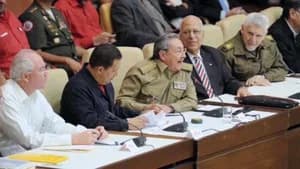
In the post-Soviet world, the Castros find mutual support in Venezuela, but the Cold War's conclusion brings the country's isolationism to an end.
Narrator (voice)

Michael Palin's Hemingway Adventure is a 1999 BBC television documentary presented by Michael Palin. It records Palin's travels as he visited many sites where Ernest Hemingway had been. The sites include Spain, Chicago, Paris, Italy, Africa, Key West, Cuba, and Idaho. After the trip was over Michael Palin wrote a book about the journey and his experiences. This book contains both Palin's text and many pictures by Basil Pao, the stills photographer who was on the team.

For the first time, an international film crew captures the round-the-clock action at Havana’s José Martí International Airport. Cuba’s elite security forces battle drug traffickers, arms smugglers, money launderers, and forgers to protect the nation’s borders. With over 100 agents on constant alert, more than 9 million travelers pass each year through this key hub, just 20 kilometers from Havana’s center. Working alongside the UN Aircop Group, specialized migration teams combat illegal migration routes used by criminals worldwide. Every hour brings new challenges—from smuggling weapons, cash, and undeclared goods to complex narcotics operations. Trained in passenger profiling and detection, the narcotics division plays a critical role. Organized crime knows no borders, but here, security forces stand ready to stop it.


Communism spread to all of the continents of the word, lasting through four generations and over seven decades. Hundreds of millions of men and women were affected by this political system, one of the most unjust and bloodiest in history. Using newly discovered propaganda films and archival photos, these four episodes explore the mysteries of this totalitarian political machine that lured its share of important followers into the fold. Known as the red church, communism seduced its ardent followers like some earthly religion.

The story of an empire: From its founding in 1922 to its dissolution in 1991, the Soviet Union was shaped by revolutionary idealism, but also by oppression and decay. The USSR evolved from Stalinist terror through the Thaw under Khrushchev to political processes such as glasnost and perestroika under Gorbachev. Finally, in 1991, it collapsed.

It started with Lenin and ended with Gorbachev. In this three-part documentary we highlight the people and events that played key roles in the rise of a revolutionary idea and the fall of an empire. How was it possible that this idea could fascinate so many people, including hundreds of intellectuals? How did so many thousands of people put up with suppression, indignity and economic hardship and still remain true to the fundamental concepts of communism?


China: The Making of a Nation is the story of the painful transformation of the vast Qing Empire into the Chinese nation after the 1911 revolution. Spanning more than a century up to the Xi Jinping era, the story pits the two pivotal leaders of this transformation against each other: Chiang Kai-shek, leader of the Republic of China for 47 years, and Mao Zedong, who rose from ‘red bandit’ to master of the mainland in 1949. Sworn enemies, they fought a merciless battle: first military, then diplomatic, and finally, beyond their deaths, in the conflicting memories of the Taiwanese and the Chinese of the People's Republic. Beyond their fierce hatred, the two tyrants also had much in common: a certain vision of Chinese territory and the greatness of China, the desire to regain the country's sovereignty and the quest for a Chinese identity in a nation that also includes Tibetans, Uighurs, Mongols... and a certain ability to rewrite history.