
Loading titles…
Documentary
A two-hour dvd of one of Sandor’s fermentation workshop, including demonstrations of making kefir and sauerkraut, as well as the history of fermentation and cultured foods, tips on fermentation vessels and storage, and information about micro-organisms, pre-digestion, and food…
Himself


In the late '50s, John Lennon, Paul McCartney, George Harrison, and Richard Starkey were just four Liverpudlian teenagers who decided to play music. With no formal training and no ability to read or write music, they tried to emulate their American rock heroes. Within a few years, they would change music history (and the world) forever. Scott Freiman traces the birth of the Beatles from their days as the Quarrymen to their first visit to EMI Studios and the recording of “Love Me Do.”
This documentary dives into Tromsø's vibrant street art scene, following two local graffiti writers. In a city known for its wild nature and extreme seasons, a subculture of expression and rebellion flourishes. The film explores questions of public space, community, and voice in a remote but connected place.


Unsupersize Me documents the inspiring story of Juan-Carlos Asse, owner of Zen Fitness, a personal training studio in Gainesville, Florida, and his quest to prove that a whole foods, plant-based diet coupled with an exercise regimen is capable of remarkably and rapidly improving the health of any and every individual. Asse takes his lifelong passions of fitness and nutrition setting out to demonstrate what he has witnessed in his training studio time and time again. The plant-based diet with exercise is the most effective and expeditious way to obtain optimal health.

A filmmaker and rapper duo revive Michel Gondry’s “Be Kind Rewind” protocols - a set of filmmaking “rules” with which groups of strangers can conceive, shoot, and screen a film in just two and a half hours. Against the grim backdrop of the stringent Shanghai lockdown, the event soon turns into a sanctuary for individuals to forge collective dreams.
SUPERCHARGE ME! is a life blessing message for everyone, said one reviewer. Ever wonder what the opposite of the film SUPER SIZE ME would be like? With a tip of the headdress to Morgan Spurlock of SUPER SIZE ME, Jenna Norwood takes us on her journey to see what happens when she enrolls in a raw food detox center and consumes only organic, raw, enzyme-rich foods for 30 days. It is all in an effort to fit into a Las Vegas showgirl costume for Halloween, but the experience has some surprising results. Meet experts (David Wolfe), celebrities (Ben Vereen & Kathy Sledge) and others seeking to resolve serious health issues on a raw food diet. Takes the mystery out of colon hydrotherapy, too. An entertaining, educational and inspiring documentary.

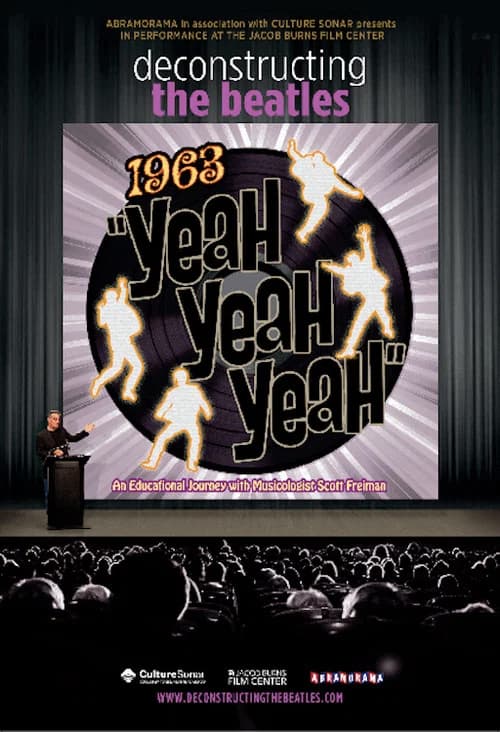
In late 1962, the Beatles stepped into EMI studios for the first time, meeting producer George Martin and beginning an unparalleled and remarkable recording career. Over the next eighteen months, they would release four number one singles (including “She Loves You” and “I Want To Hold Your Hand”) and two number one albums while becoming worldwide superstars. In Deconstructing The Beatles 1963 Yeah! Yeah! Yeah!, Scott Freiman explores the music that helped launch Beatlemania.

This series comprised six lectures on music, which cumulatively took the title of a work by Charles Ives, The Unanswered Question. Bernstein drew analogies to other disciplines, such as poetry, aesthetics, and especially linguistics, hoping to make these lectures accessible to an audience with limited or no musical experience, while maintaining an intelligent level of discourse: Lecture 5 picks up at the early twentieth century with an oncoming crisis in Western Music. As these lectures have traced the gradual increase and oversaturation of ambiguity, Bernstein now designates a point in history that took ambiguity too far.

This series comprised six lectures on music, which cumulatively took the title of a work by Charles Ives, The Unanswered Question. Bernstein drew analogies to other disciplines, such as poetry, aesthetics, and especially linguistics, hoping to make these lectures accessible to an audience with limited or no musical experience, while maintaining an intelligent level of discourse: This lecture takes its name from a line in John Keats' poem, "On the Grasshopper and Cricket". Bernstein does not discuss Keats' poem directly in this chapter, but he provides his own definition of the poetry of earth, which is tonality. Tonality is the poetry of earth because of the phonological universals discussed in lecture 1. This lecture discusses predominantly Stravinsky, whom Bernstein considers the poet of earth.
