Loading titles…
No cast information available.


Holocaust survivors, children of survivors, and grandchildren - as well as German freedom fighters - express their shock at the Covid era's fear-mongering and divisive dictates that are reminiscent of the prelude to the Holocaust. This ambitious five-part docu-series is the brainchild of Holocaust survivor and human rights activist Vera Sharav.


13 years ago, director Bob Entrop made the film A piece of blue in the sky, the first film in the Netherlands that depicted the murder of almost 1 million Sinti and Roma during the Second World War. There is a taboo on what happened during the war, you don't talk about it with anyone and certainly not in front of a camera. Requiem for Auschwitz is a sequel, with the most valuable moments from the first film, supplemented with the grandchildren and the creation and performance of the 'Requiem for Auschwitz' by Sinti composer Roger Moreno Rathgeb by the Sinti and Roma Philharmonic from Frankfurt and a Jewish choir in the Berliner Dom in Berlin, during Holocaust Memorial Day. During his visit to Auschwitz in 2020 with four musicians from the Dutch Accompaniment Orchestra, Roger shows them the places that inspired him.

The first woman rabbi in the world, Regina Jonas, comes to light, courtesy of Rachel Weisz – who plays her – and her father George Weisz, who was the executive producer for this poetic and beautiful documentary. The daughter of an Orthodox Jewish peddler, Jonas was ordained in Berlin in 1935. During the Nazi era and the war, her sermons and her unparalleled devotion brought encouragement to the persecuted German Jews. Regina Jonas was murdered in Auschwitz in 1944. The only surviving photo of Jonas serves as a leitmotif for the film, showing a determined young woman gazing at the camera with self-confidence.
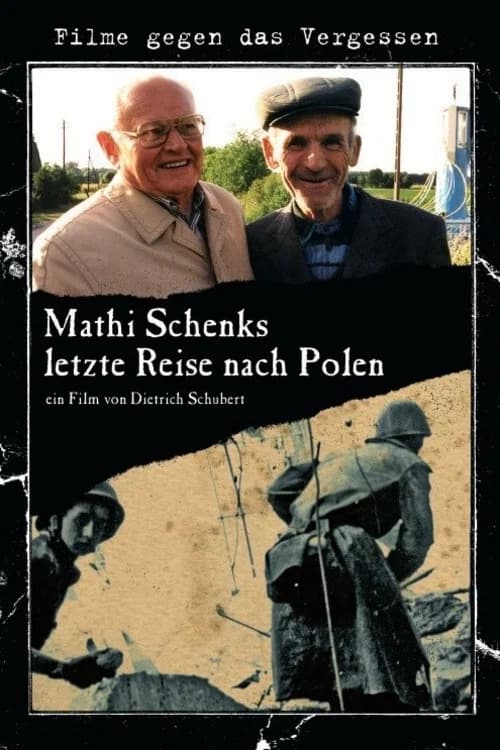
In the summer of 2001, 75-year-old Mathi Schenk made his last trip to Poland, following in the footsteps of his own past. He lives in the eastern cantons of Belgium, which were forcibly united with the German Reich after the invasion of German troops in May 1940. Those who did not volunteer for the Wehrmacht were – like Mathi Schenk – sent to war as forced soldiers for Germany. When the Warsaw Uprising broke out in August 1944, the 18-year-old arrived in the Polish capital and was assigned to the notorious SS Dirlewanger Brigade. During the 63 days of bitter fighting, which cost the lives of more than 200,000 Poles, he witnessed unimaginable atrocities against the people of Warsaw. While fleeing the Red Army, Polish farmers found the young soldier wounded in a ditch. Despite his German uniform, they hid him from the Russians in their village.
Chicken Soup With Knives is a personal documentary that chronicles filmmaker Leora Eisenstein’s journey (with her sister and other companions) to Lviv, her family’s hometown before World War II. There, she embarks on a search for her roots as well as a sense of justice. The journey from Israel to Ukraine encompasses meetings with current residents of Lviv, family reunions, and personal reflections. All of these elements converge as the film maps the effects of the past—and all of its painful memories—on the present.