
Loading titles…

Self (archive footage)

Self

Self

Self
Self
Self

Self

Self

Self

Self
Self
Self

A group of people are standing along the platform of a railway station in La Ciotat, waiting for a train. One is seen coming, at some distance, and eventually stops at the platform. Doors of the railway-cars open and attendants help passengers off and on. Popular legend has it that, when this film was shown, the first-night audience fled the café in terror, fearing being run over by the "approaching" train. This legend has since been identified as promotional embellishment, though there is evidence to suggest that people were astounded at the capabilities of the Lumières' cinématographe.

In 1900, the eyes of the whole world are on Paris. The World's Fair welcomed 50 million amazed visitors, and the city celebrated itself in a glamorous era. This period went down in history as the "Belle Époque." Elaborately restored and colorized historical photographs bring to life the exciting life in Paris between the end of the 19th century and the beginning of World War I in 1914. Bicycles, cars, airplanes, moving pictures, newly founded film studios, revolutionary composers and painters, avant-garde ballet performances, fashion houses, summer resorts on the Atlantic coast – life was intoxicating. People celebrate in the variety shows, cabarets, and revue theaters of Paris. Moulin Rouge, Folies Bergères, Bal Tabarin—in Paris, the nights are long and life is too short to sleep through. It is a dance on the volcano, given the political developments in the world.

"Well, I believe in anarchy! And I believe it will come true one day." That's what "May the Rebel," a union activist, anti-militarist, and anarchist, always ready to denounce oppression and defend victims, affirms at 85. Born in Brittany, she earned her living at age 10 delivering butter. In Paris, at 20, she became involved with the Anarchist Union. Sébastien Faure became her mentor. She used a grenade to trigger the Sacco-Vanzetti affair. A union delegate in Moscow in 1922, she sang "Hymn to Anarchy" before Trotsky. Children during the Spanish Civil War, Jews during the Second World War, conscientious objectors alongside Louis Lecoin during the Algerian War, and later, through her newspaper Le Réfractaire, the Larzac, Plogoff, and Creys-Malville protests—all these were battlegrounds for May Picqueray. To the very end, she remained true to her commitment to defending peace and individual liberties.

Everyone knows Aguigui Mouna, the jester who harangues the crowds on the Beaubourg esplanade in Paris and rides his bicycle through demonstrations. But many don't know the story of André Dupont, a Savoyard raised in tough conditions, forced into violence in the navy to rise to power and into resourcefulness in civilian life to survive. Antibes, 1952, the transformation: Aguigui Mouna is born. Laughter, solidarity, non-violence, humanism—Mouna has found the meaning of his existence. He will try to share them with all the robots of this "poop-pee-capitalist" society. A comic book character who, through his adventures, reveals the absurdities of his century.

Filmmaker Froukje van Wengerden’s 86-year-old grandmother shares a powerful memory from 1944, when she was just 14. As her story unfolds, we see a group of contemporary 14-year-old girls. Their procession of portraits permits the spectator to see simultaneously forward and back, into the future and towards the past. A miraculous testimonial that uses eye contact to focus the viewer inward and evoke unexpected emotions.

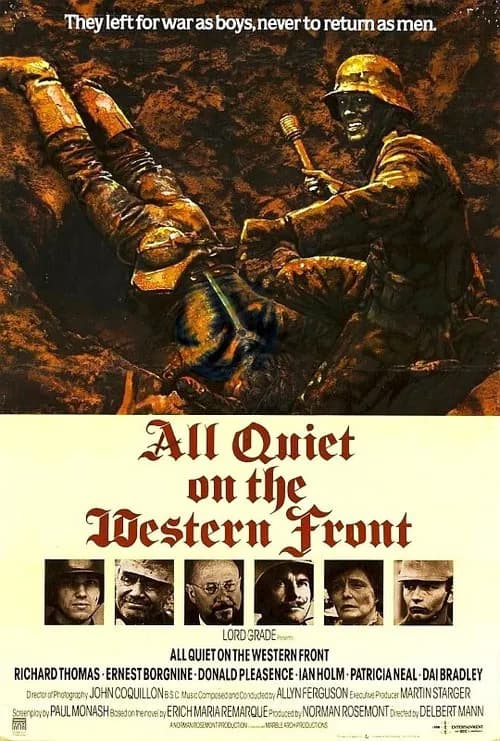
At the start of World War I, Paul Baumer is a young German patriot, eager to fight. Indoctrinated with propaganda at school, he and his friends eagerly sign up for the army soon after graduation. But when the horrors of war soon become too much to bear, and as his friends die or become gravely wounded, Paul questions the sanity of fighting over a few hundreds yards of war-torn countryside.

Since the law of August 2, 2021, on bioethics, French women between the ages of 29 and 37 have the right to collect and freeze their eggs, free of charge, without medical reason, regardless of their marital status. From this simple law, and thus from this right, emerges a complex and fascinating reality.


Between the nostalgia of resurfacing roots and the desire to venture into song to experience a rebirth, Nicolas Maury reveals himself unguarded before Didier Varrod, with a deeply moving sincerity. Nicolas Maury released his first album, La porcelaine de Limoges, in January 2023—a new experience for this unique, demanding, and multifaceted actor. It is an opportunity to paint an intimate portrait of him through an extended interview on a train between Paris and Limoges. In this specific setting, which was also that of his first (silent) film role with Patrice Chéreau in Those Who Love Me Can Take the Train, Nicolas discovers archives and hears from close acquaintances who speak about him. A documentary film, like a kind of initiation rite, it moves back and forth between memories of France and childhood, and his condition as a man and artist today, taking on a new identity through music.


