Loading titles…
Discover the terrifying truth behind one of the most sinister yet effective organisations of the past century, as we take an in-depth look inside the Nazi war machine. Examine the technology that enabled Hitler's Nazi regime to spread death and destruction across Europe and far…
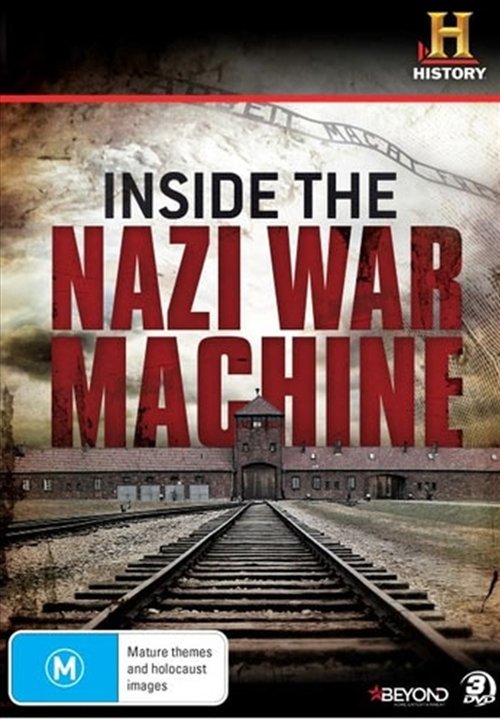
Just a few years ago, a German family cleaning their attic discovered the original blueprints to one of history's most gruesome constructions: the infamous concentration camp at Auschwitz. The diagrams, never before seen on television, illustrate in painstaking detail the methods behind the madness of the Holocaust. While the Holocaust has become a symbol of man's gravest inhumanity, it was as much an elaborate machine as any of man's other inventions. This feature-length portrait of the evolution of the Holocaust takes us from the early days of persecution in Nazi Germany to the final days of wanton annihilation. Travel through the archives of Eastern Europe, the United States Holocaust Memorial Museum in Washington D.C. and the restoration labs of Yad Vashem in Israel to hear the story of persecution, theft and murder told through artefacts, rarely seen photographs and motion picture footage.
This special collection shines the spotlight on the Axis weapons and technology of WWII, on land, sea and air. We begin with a closer look at how the speed and firepower of Germany's devastating Panzer tanks dominated the battlefields of WWII and revolutionised military strategy, before moving on to examine the crucial role of the Nazi Luftwaffe, the airbourne fighting force under the command of Hitler's right-hand man, Hermann Goering. As the military arm responsible for the Blitz bombing raids on Britain, evidence of the destructive power of the Luftwaffe can still be seen today. From the many aircraft at their disposal to the pilots themselves, we look at what made the Luftwaffe such a formidable fighting force. Finally, take to the water and discover the fascinating truth behind the ferocious 'wolf packs' of German U-Boats that prowled the waters of the Atlantic in search of enemy shipping.
This special collection shines the spotlight on the Axis weapons and technology of WWII, on land, sea and air. We begin with a closer look at how the speed and firepower of Germany's devastating Panzer tanks dominated the battlefields of WWII and revolutionised military strategy, before moving on to examine the crucial role of the Nazi Luftwaffe, the airbourne fighting force under the command of Hitler's right-hand man, Hermann Goering. As the military arm responsible for the Blitz bombing raids on Britain, evidence of the destructive power of the Luftwaffe can still be seen today. From the many aircraft at their disposal to the pilots themselves, we look at what made the Luftwaffe such a formidable fighting force. Finally, take to the water and discover the fascinating truth behind the ferocious 'wolf packs' of German U-Boats that prowled the waters of the Atlantic in search of enemy shipping.
This special collection shines the spotlight on the Axis weapons and technology of WWII, on land, sea and air. We begin with a closer look at how the speed and firepower of Germany's devastating Panzer tanks dominated the battlefields of WWII and revolutionised military strategy, before moving on to examine the crucial role of the Nazi Luftwaffe, the airbourne fighting force under the command of Hitler's right-hand man, Hermann Goering. As the military arm responsible for the Blitz bombing raids on Britain, evidence of the destructive power of the Luftwaffe can still be seen today. From the many aircraft at their disposal to the pilots themselves, we look at what made the Luftwaffe such a formidable fighting force. Finally, take to the water and discover the fascinating truth behind the ferocious 'wolf packs' of German U-Boats that prowled the waters of the Atlantic in search of enemy shipping.
WWII ended not with a whimper but with a bang, as the Allied forces' famous Manhattan Project succeeded in developing the first operational atomic bombs, dropped on the Japanese cities of Hiroshima and Nagasaki with devastating effect. The crucial scientific breakthrough made by the scientists involved resulted in a decisive strike that swiftly ended the war, but few know how close the Axis powers came to developing a nuclear capability of their own. The Nobel Prize-winning German physicist Werner Heisenberg, author of the famous uncertainty principle, led the scientific research team that aimed to develop atomic weapons for the Nazis. Along with numerous high-profile colleagues, Heisenberg was captured by the Allies in May 1945 and the Nazi nuclear program never came to fruition. Yet it may be that Heisenberg, with the aid of a U.S. spy, sabotaged his own work to ensure it would fail. Could these rumours be true, and if so, who was the spy?
No cast information available.
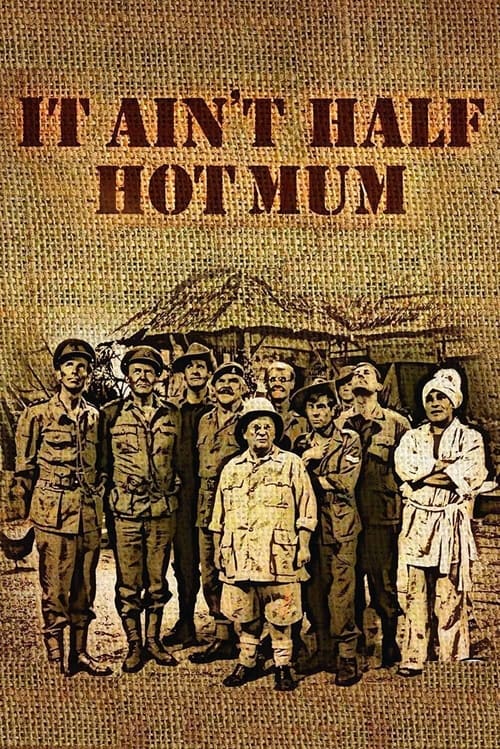
In 1945, during the final months of the Second World War, a group of soldiers perform for the Royal Artillery concert party, with comic acts and musical numbers for others prior to their departure for the frontlines. The party avoids partaking in combat duty; thus, the soldiers love being part of the outfit. Some even daydream of becoming world-famous actors when they leave the army.

Centuries after the events of Saga Brave, a third race called the Mauve has emerged alongside Humans and Mazoku. Identified by their purple blood and immense intelligence, the Mauve are shunned by the other two races and are viewed as a threat to the peace of the world. Having experienced this prejudice first-hand, a teenage Mauve named Galette Revolt journeys forth to find a way for all races to understand each other by playing Battle Spirits. However, other factions from each race aim to maintain the peace/reform the world through more nefarious ways...

The Bletchley Circle follows the journey of four ordinary women with extraordinary skills that helped to end World War II. Set in 1952, Susan, Millie, Lucy and Jean have returned to their normal lives, modestly setting aside the part they played in producing crucial intelligence, which helped the Allies to victory and shortened the war. When Susan discovers a hidden code behind an unsolved murder she is met by skepticism from the police. She quickly realises she can only begin to crack the murders and bring the culprit to justice with her former friends. The Bletchley Circle paints a vivid portrait of post-war Britain in this fictional tale of unsung heroes.

Sharpe is a British series of television dramas starring Sean Bean as Richard Sharpe, a fictional British soldier in the Napoleonic Wars. Sharpe is the hero of a number of novels by Bernard Cornwell; most, though not all, of the episodes are based on the books. Produced by Celtic Films and Picture Palace Films for the ITV network, the series was shot mainly in Turkey and the Crimea, although some filming was also done in England, Spain and Portugal. The series originally ran from 1993 to 1997. In 2004, as part of ITV's new set of drama, ITV announced that it intended to produce new episodes of Sharpe, in co-production with BBC America, loosely based on his time in India, with Sean Bean continuing his role as Sharpe. Sharpe's Challenge is a two-part adventure; part one premiered on ITV on 23 April 2006, with part two being shown the following night. With more gore than earlier episodes, the show was broadcast by BBC America in September 2006.

In 1910s China, nineteen year old Xie Xiang follows in her deceased brother's footsteps and enrolls in military school disguised as a man. She befriends her fellow cadets and and earns the respect of her instructors during the intense training. However, when the unfortunate arrival of the Imperial Japanese troops creates a web of distressing conspiracies, the batch and their allies are forced to prove their courage and resilience.